
Fridge door. Shot glass. Done.
Cold, sharp, and you filled the bottle yourself.
For people who already eat this stuff
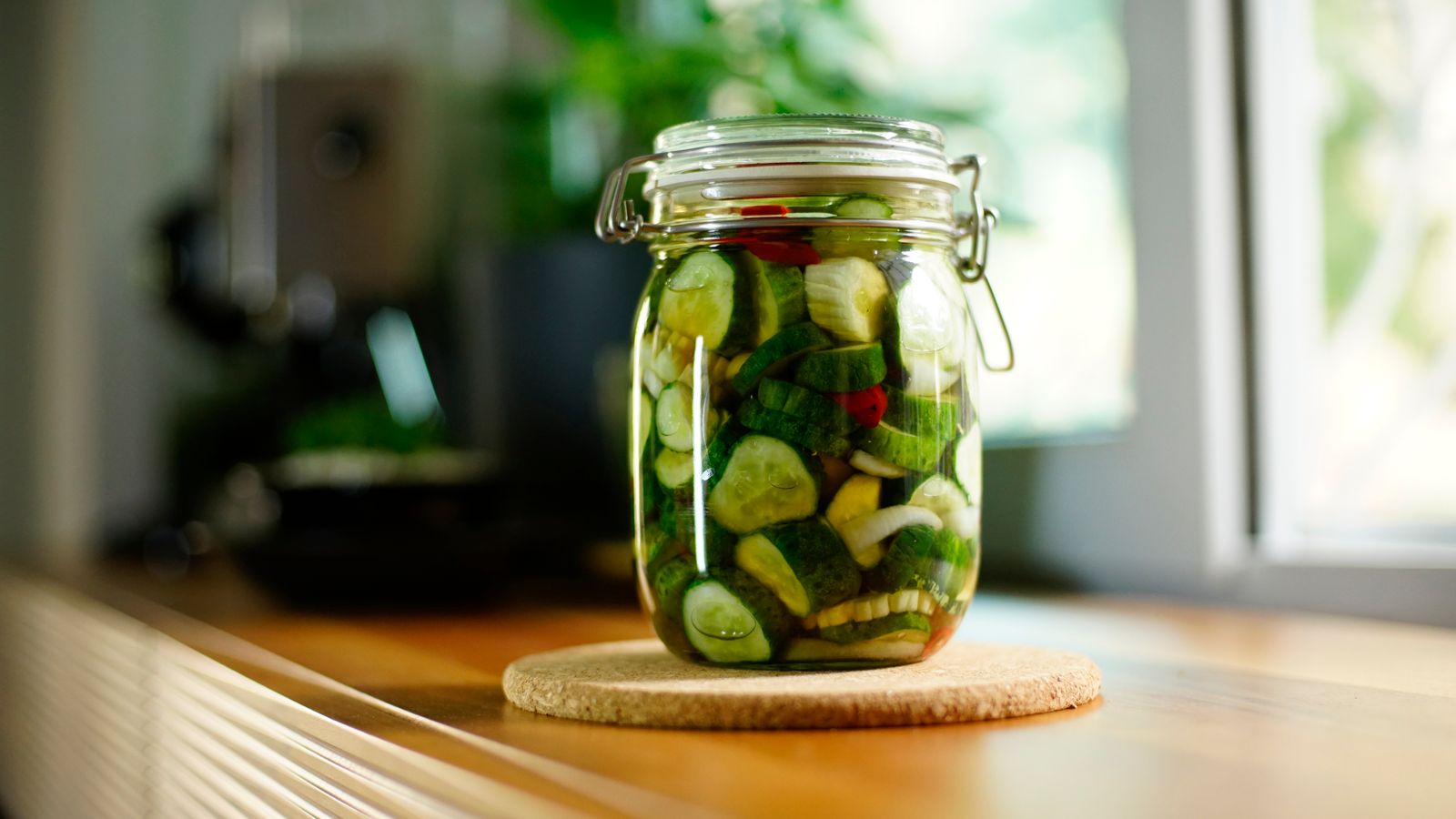
Onions, cucumbers, peppers, carrots. A jar, some salt, five days of doing absolutely nothing, and the shelf in your refrigerator looks like this. Then there is the brine, which is the four-dollar morning shot everybody is buying and almost everybody pours down the sink.
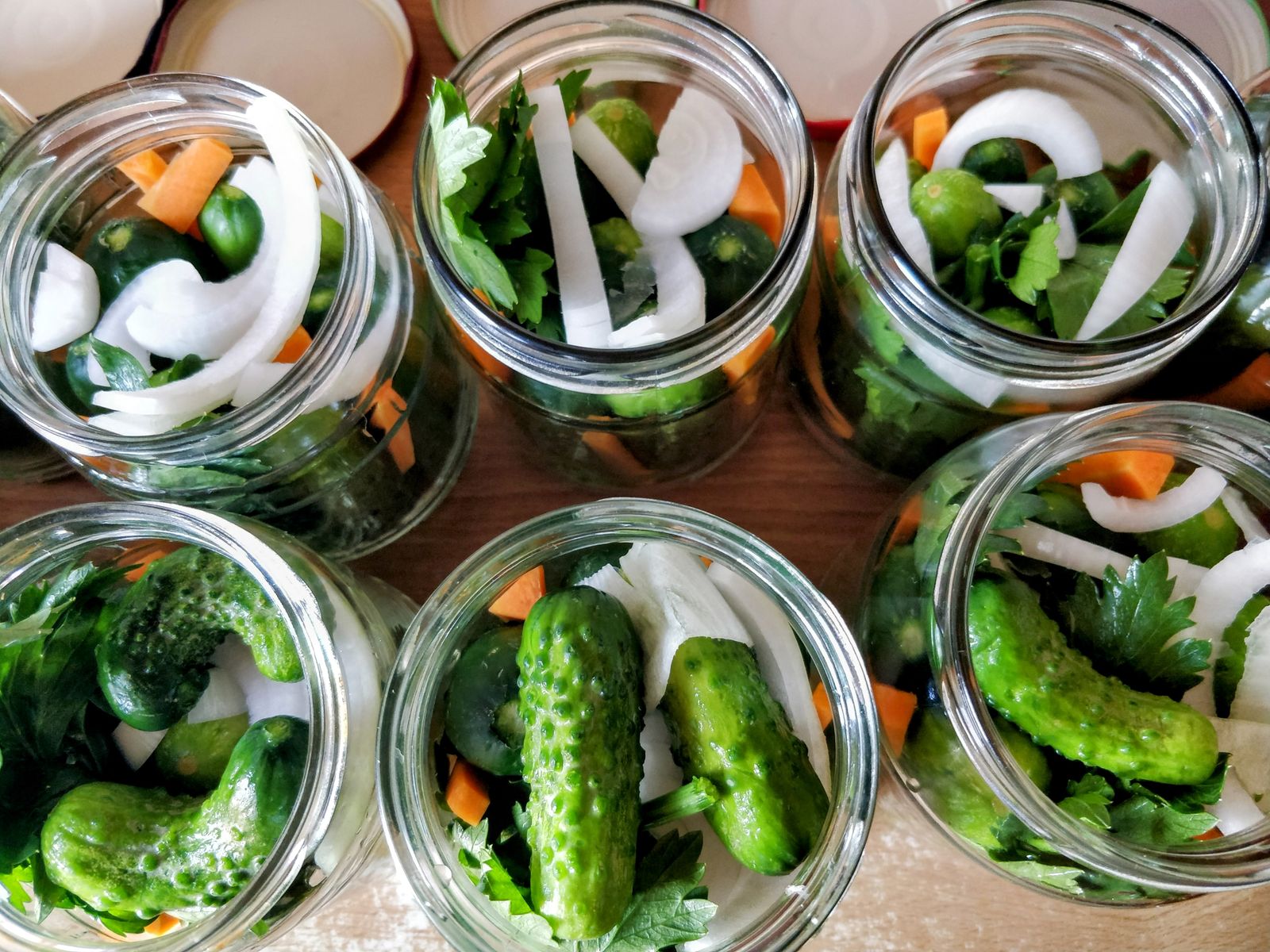
Go open your refrigerator and look at what is in there.
The bread is dead. The chips are dead. The dressing, the sauce, the jar of pickles you bought last month. Every bit of it got cooked or sterilized or sealed until nothing inside was moving anymore.
All of it finished happening in a factory, months ago, before you ever saw it.
Now open your pantry. Pick up anything in a box or a bag and turn it around. Count the ingredients. There are going to be fifteen, twenty, thirty of them. Half of them are anti-caking agents, preservatives, stabilizers. Words you have never said out loud. They are there so the product can sit on a shelf for two years without changing.
Your body has to do something with every one of those ingredients. It does not get to skip the ones it cannot pronounce.
You have thought about this. Even if you have never said it out loud.
Now put one jar in there that is still alive.
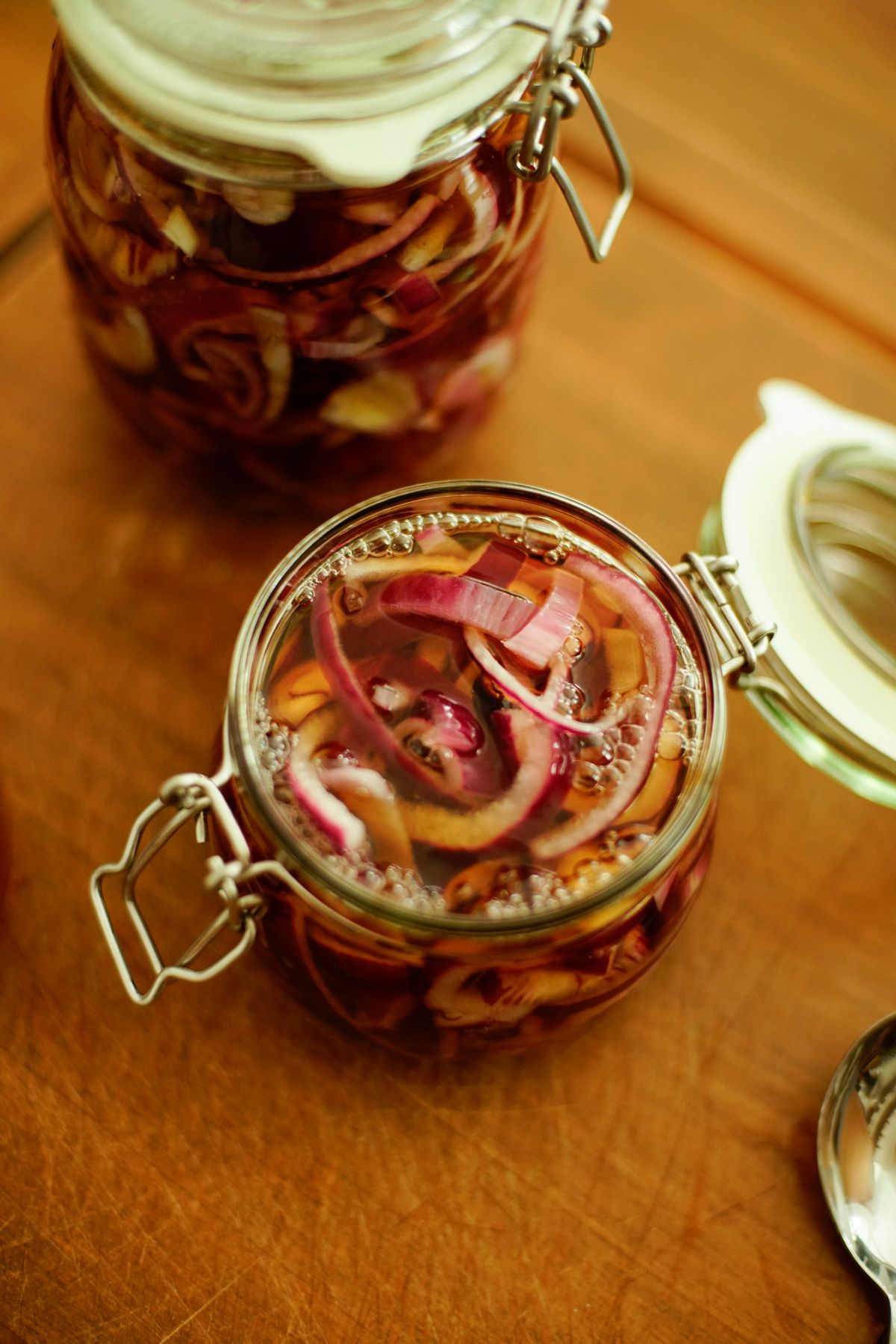
Here is what that actually looks like. You slice a red onion on a Sunday afternoon. It takes four minutes. You put it in a jar with salt water and you walk away.
Tuesday, the brine turns pink. Not a little pink. Neon.
Wednesday it starts to fizz, faintly, and if you put your ear near the lid you can hear it, which is a genuinely strange thing to do in your own kitchen and you are going to do it anyway.
Friday you open it. It resists for a second, then gives, with a small carbonated crack. It smells sharp and clean and a little sour. You eat one straight out of the jar with your fingers because it is your kitchen.
You made that. Nobody helped. It cost about a dollar.
And nothing in the rest of your refrigerator did anything at all this week.
I could sell you this as health food. It is food that is still alive, and I will show you exactly what that means further down the page.
But nobody makes a second jar because it was good for them. They make the second one because the first one was fun.
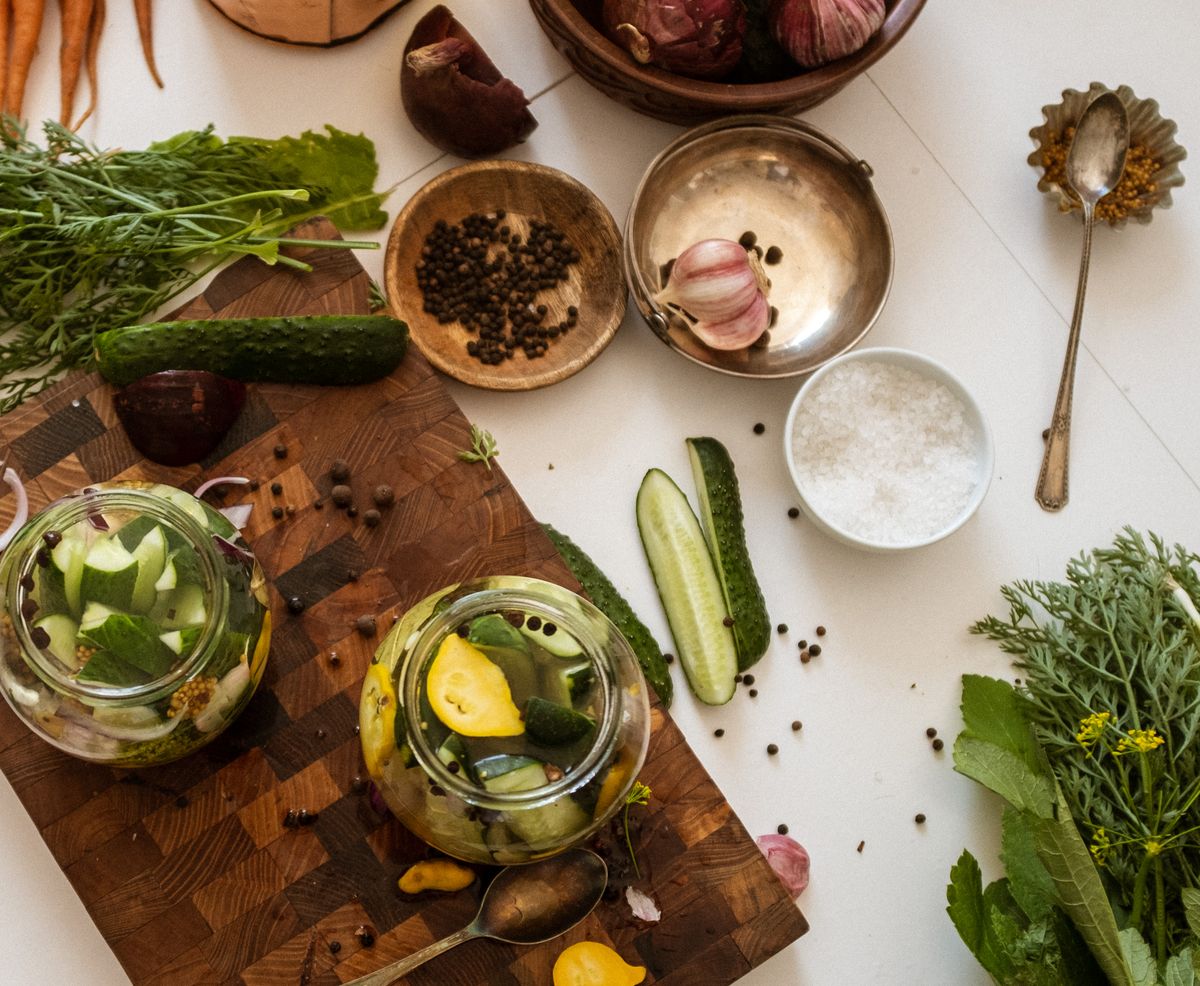
Here is what I mean by fun.
You get to invent things. Once you have the base method, everything after it is up to you. More garlic. A dried chili. A strip of lemon peel. Fennel seed, because you had some in the back of the cupboard. Ferment it at 68 degrees instead of 72 and it comes out different, and you will taste the difference, and you will have an opinion about it.
Nobody is grading you. There is one number you have to get right and after that it is a sandbox.
You end up with a signature. Everybody who does this for a few months has one jar that is theirs. The spicy carrots. The onions that go on everything. People start asking for it by name, and at some point you become the person who brings the jar.
You get to give it away. A jar of something you made, with a handwritten label on it, is a better gift than most things people spend forty dollars on. It costs you two dollars and ten minutes and it lands like you spent a Saturday.
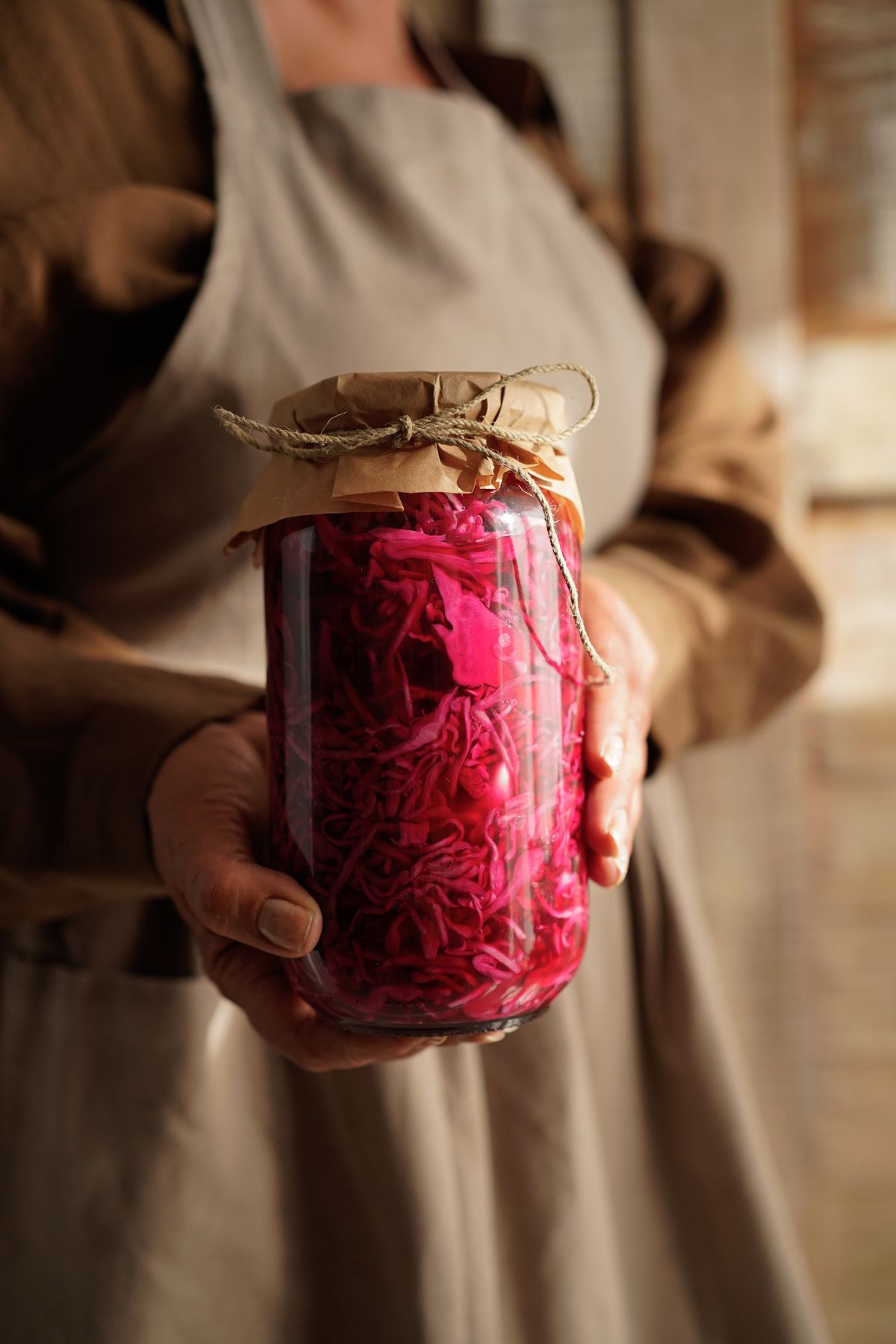
And your kitchen starts looking like somebody lives in it. Six jars on a shelf. Neon pink onions next to orange carrots next to something with a chili floating in it. It is the best-looking thing in most kitchens and it happened by accident, as a side effect of food.
It is cheap to start, impossible to get bored of, and you eat the homework.
Every hobby I have ever picked up wanted money and a garage. This one wants a jar and a Sunday, and it feeds you back.
Gallup has been asking Americans the same question since 1939. Do you drink.
In July 2025, 54% said yes. That is the lowest number in the entire eighty-seven year run, one point under the old floor from 1958. Go look it up, it took me nine seconds.
But nobody gave up the ritual. Watch what people actually do. They still want the small cold glass, the tilt of the wrist, the sharp thing that makes your face move. They just stopped wanting what used to be in it.
So the glass got refilled with something else.
In January 2023 the Wynn in Las Vegas put a mixologist on a non-alcoholic beverage program and called it Drinking Well. Las Vegas. The city built on the other thing. Walk into a juice bar and a one-ounce ginger shot is four dollars, five twenty if you are in Chicago. One ounce. People pay it every morning and line up to do it.
Meanwhile athletes have been drinking pickle brine straight out of the jar on the sideline for forty years and nobody ever called that wellness.
Same glass. Same sour. Same salt.
And here is the part that got me, because I paid for the expensive version first and I did not work it out for about a year.
You are not buying the shot. You are buying the liquid that a jar of vegetables makes for free, while you sleep, as a side effect of the thing you already wanted to eat.
Most people pour it down the sink.
One more thing before I tell you how I ruined a year of jars.
Ten years ago, telling somebody you ferment vegetables at home got the same look as telling them you collect stamps. That is over. There are companies running facilities the size of warehouses now, shipping live fermented food in refrigerated boxes. There are cold bottles of brine in the cooler at the gym. Actors drink it on camera.
People spent real money making this look good, and it worked, and I am not going to throw rocks at them for it. They built the category. Nobody was buying a jar of live cucumbers from anybody in 2014.
I am on their side. I just think you should also know how to make it.
Because what is in those bottles is vegetables, salt, water and time. That is the whole technology. It is thousands of years old, every culture on earth worked it out independently, and a ten-year-old can do it.
They are selling a finished product, which is a fair thing to sell. What none of them can sell you is the Sunday afternoon, because that is not a product. It is a skill, and it takes one evening to learn.
Buy theirs when you want to. I still do. Just stop believing you could not have made it.
Cucumbers. I had followed the recipe to the gram. I opened it and they had gone soft, the brine had gone cloudy, and the whole thing smelled like a wet basement.
So I did what you would do. I went online. I read forty opinions from forty strangers. Add a grape leaf. Add a tea bag. Use a crock. Never use a crock. Your house is too warm. Your house is too cold. Somebody said the moon.
Not one of them asked me what salt I was using. That turned out to be the entire answer.
I will come back to the salt, because it is the reason this page exists.
First, one short story about why nobody could answer a simple question about a jar of cucumbers.
I want to name the villain properly, because it is not a boardroom and it is not a conspiracy. It is two of the best ideas in human history, and they had a side effect nobody planned.
Captain Cook loaded 7,860 pounds of sauerkraut onto a warship.
The Endeavour sailed with nearly four tons of fermented cabbage and lost nobody to scurvy on a three-year voyage. Cook also carried malt, spruce beer and portable soup, so kraut was not the only variable. But the Navy trusted fermentation enough to provision a warship with it. That is not a fringe idea. That is an institution betting lives on a jar.
Louis Pasteur was right.
In the 1860s he worked out that invisible organisms spoil food and make people sick. Heat them and the problem goes away. That single idea took milk from something that killed children to something you hand a child without thinking about it. I am not going to stand here and be clever about pasteurization. It is one of the great achievements and it saved an enormous number of lives.
Then the refrigerator showed up, and it ended the argument.
For all of human history before that, if you wanted a vegetable in February you had to have done something about it in September. Salt it, bury it, ferment it. That was not a hobby, it was Tuesday, and every culture on earth invented some version of it independently because the alternative was going without.
A cold box in your kitchen made all of that optional. In about two generations, a skill that every household had became a skill that no household needed.
And the lesson we all absorbed was: bacteria are the enemy.
This is the part that actually costs you something.
A century of genuinely good public health messaging taught everybody the same reflex. Wash it, cook it, seal it, chill it. Bacteria make you sick. If something has been sitting on the counter for a week, throw it out.
You have done it. Opened the lid on something that sat out for three days, smelled it, and poured it down the sink just in case.
That reflex is correct almost every time you use it. It is also the exact reason a jar of cucumbers on your kitchen counter feels like it might hurt you.
So here is what nobody put on the other side of the ledger.
We learned to kill microbes. We could not pick which ones. The same processes that made food safe also made it dead. Sterile is the default now.
Open your refrigerator. Everything in there had every living thing removed from it on purpose, by people who were doing their jobs correctly. It is a cold box full of food that cannot spoil because nothing inside it is alive.
Nothing was stolen from you. We just won a war so completely that we forgot some of the bacteria were on our side.
Meanwhile, with nobody making it at home, the jar on the shelf drifted.
Vinegar replaced fermentation, because vinegar is faster and shelf-stable and does not die in a warehouse. Sugar went in, because sugar sells. The jar kept the name and quietly stopped being the food.
And once in a while somebody checks. Red No. 3 came out of lipstick in 1990. It stayed in food for another thirty-five years. You could not put it on your face, but you could put it in your kid. The FDA finally pulled it in January 2025, with until January 2027 to clear the shelves. Thirty-seven years, start to finish.
The FDA will tell you it was a legal technicality and never a danger to anybody. Fine, I will take them at their word. Then somebody explain 1990.
And now the easy thing looks hard, because the noise filled the silence.
When a skill stops being ordinary, the conversation around it expands to fill the empty space. Airlocks. Crock weights. Temperature charts. pH meters. Forty strangers arguing about grape leaves.
Worse, the person is gone. Not the technique, which is written down in a hundred books. The aunt who would look in your jar, sniff it, and say one sentence that fixed it. When the skill left the household, the teacher left with it, and a beginner got handed a search bar instead of a grandmother.
So if a jar of vegetables fermenting on your counter makes you a little nervous, you are not being silly and you are not uninformed.
You are being exactly as careful as a hundred years of very good advice trained you to be.
The thing that advice never got around to mentioning is that this particular jar defends itself. Salt goes in at the front, the vegetables make their own acid at the back, and by the time it is finished it sits at a pH of 3.5 to 4.0, well under the 4.6 line that food safety work treats as the threshold. It is not sitting there hoping. It is one of the most hostile places in your kitchen for anything that could hurt you.
That is why the salt number matters, and it is why the number is the first thing you get.
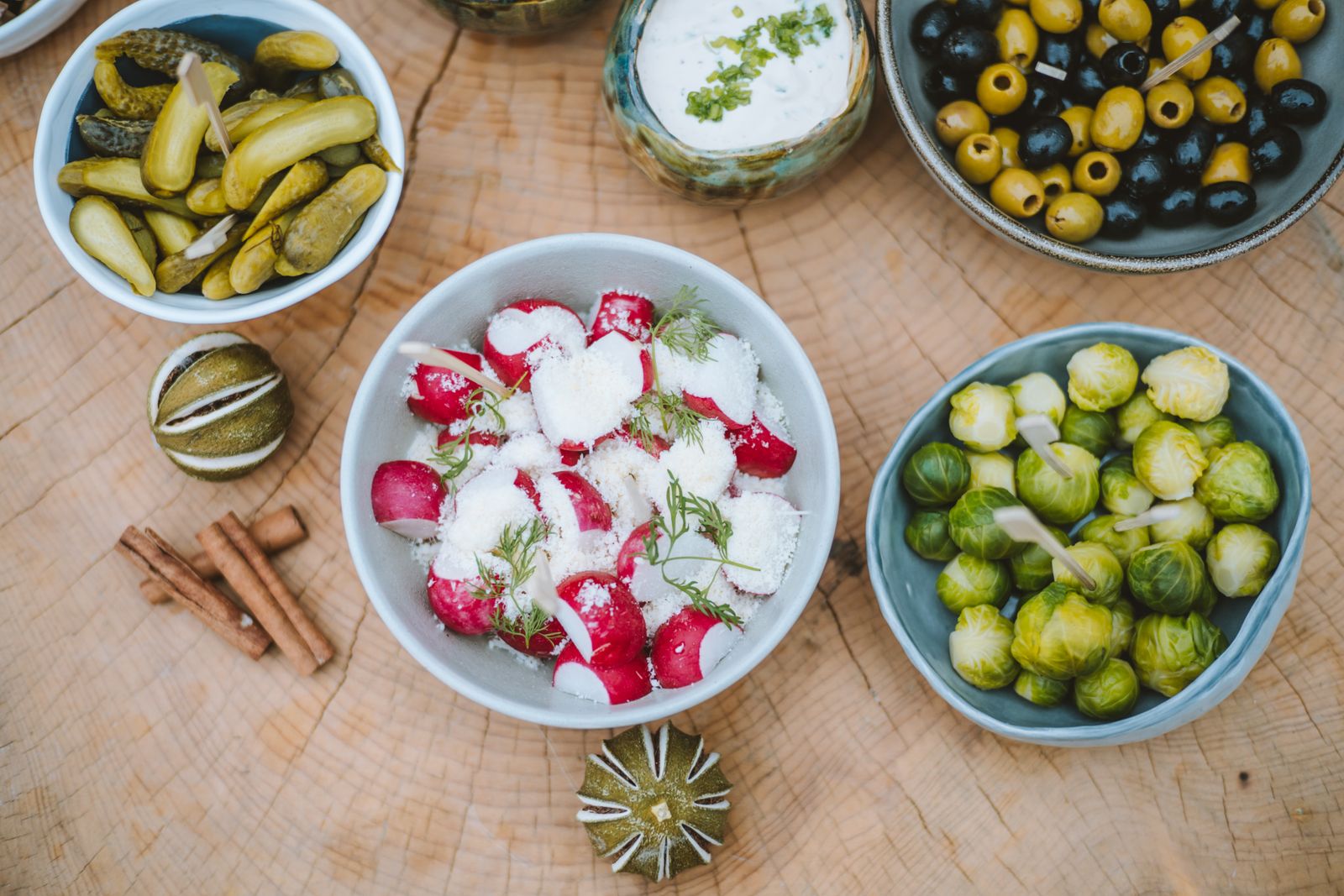
Taking it back is not a protest. It's a Sunday, ten minutes, and one number.
So let me give you the number.
Back to my ruined jar.
Mineral salt is not pure sodium chloride. Mine ran around 83%, and the rest is magnesium, potassium, calcium and water. Good things to eat. Terrible things to ignore when you are weighing.
So when the recipe said 2.5% and I weighed out 2.5%, I did not make a 2.5% brine. I made a weaker one. Every single time. For a year.
You can open the most respected book in fermentation and it will tell you to use unrefined mineral salt. Good advice, and I agree with it. That book never once mentions what the swap does to your arithmetic.
Nobody is lying to you. They just never did the math.
So I did the math. Then I sent my salt to a laboratory, because I would rather own a number than an opinion. When the certificate came back I read it line by line until I worked out which five lines actually matter. Most of that page exists to impress you. Five lines decide whether your cucumbers snap.
I call the correction the True Salinity Method.
And here is why I can sell a course about salt water. It comes down to one number you weigh. I am not going to teach you the arithmetic. I am going to hand you the answer.
You're not bad at this. You were handed a number that assumed the wrong salt.
The calculator at the bottom of this page is free, it runs the corrected arithmetic, and it stays free permanently. Use it, pack a jar, eat something alive in five days, pay me nothing.
Jump to the free calculatorA raw ferment is alive. Live lactic acid bacteria, made by the vegetables and the salt and nothing else. Heat kills them, which is why the shelf-stable pickle in your cupboard has none left. Yours never sees heat.
I'll tell you exactly what's in the jar. What it does for you is between you and your body.
They make the second one because the first tasted better than anything they could buy.
A week ago that was a cucumber and some salt water. Nobody added a thing to it. The bacteria built every bit of that flavor, for free, while you slept.
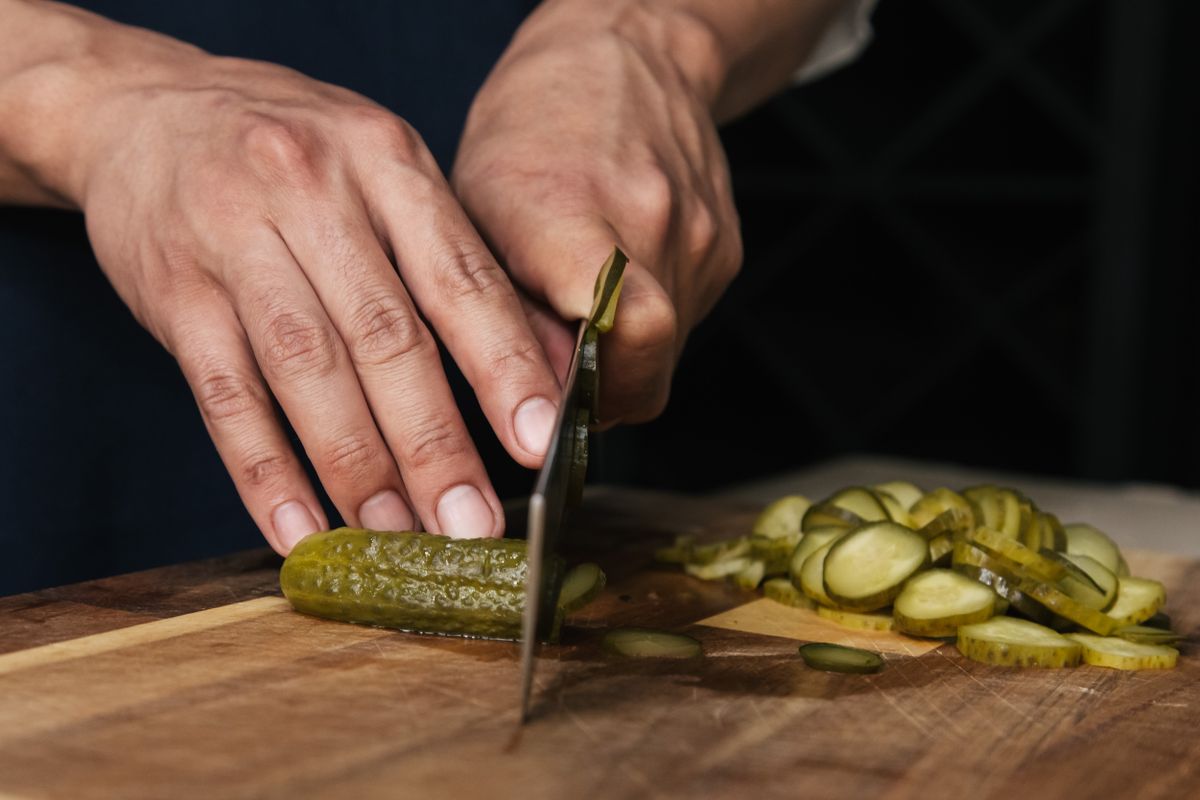
Vinegar hits flat and sharp on the front of the tongue. Lactic acid is rounder. Closer to lemon, closer to yogurt, and it keeps going after you swallow. Once you have had the real thing, shelf pickles taste like a photocopy.
Parmesan, miso, fish sauce, good salami. Same trick every time: let bacteria work on food and it turns deep and savory in a way cooking cannot reproduce. Your jar does that on the counter for free.
A raw ferment never gets cooked, so the cell walls stay intact and it snaps. That crunch is why the salt number matters. Get it right, you keep it. Get it wrong, you get a sad soft spear.
You already saw what I do with it in a glass. It is also the marinade for chicken, the acid in a salad dressing, the liquid in a potato salad and the base of a bloody mary. One jar, two things to eat, one price.
None of that is why people stop me, though. They stop me about one word: alive. The whole store is printing it on boxes now, and almost none of them can deliver it.
Walk the store and count the labels. Gut this, biome that, cultures on the front of the box in a friendly font.
Then turn the box around and find the word that decides everything.
Heated. Pasteurized. Cooked. Shelf stable.
Every one of those words means the same thing, and it is not a scandal, it is physics. Heat is what lets food sit in a warehouse for eight months and survive a truck in July. It also ends every living thing in the container. A shelf-stable pickle is a cucumber in acid somebody else made, cooked until nothing is moving. There is nothing alive left in it to sell you, whatever the front of the jar says.
Your jar never sees heat. Not once.
That is the entire difference, and it is worth understanding exactly, because once you have it you can read any label in the store in four seconds.
You put vegetables, water and salt in a jar. The lactic acid bacteria that were already on the vegetable, from the soil, wake up and start eating the sugar. They make acid. The acid is what preserves it, which is why nobody has to cook it. And they are still in there, alive, in the billions, when you take the first bite.
Nothing was added. Nothing was inoculated. No powder, no starter, no capsule. The vegetable did it and the salt made the conditions safe enough for it to happen.
That is what a live ferment is, and it lives in your refrigerator instead of your cupboard for exactly one reason. It is alive, and cold is how you keep it that way.
Stanford ran the study I would have wanted somebody to run. Wastyk and colleagues, published in Cell in 2021. Ten weeks, two groups. One ate fermented foods, including vegetable brine drinks. One ate a high-fiber diet.
The fermented-food group's microbiome diversity went up and nineteen inflammatory markers came down. The high-fiber group's did not move.
I am not going to walk you through the rest of the literature on a page where I am asking for your money. That belongs in the course, and it is in there, including the parts that argue with me.
I'll tell you exactly what's in the jar. What it does for you is between you and your body.
Cold, sharp, and you filled the bottle yourself.
Three o'clock hits the same as it always did. You just reach somewhere else.
Color on the shelf. Ten minutes of work, five days of waiting, weeks of eating.
Handwritten label. They ask how you made it. This is how the whole thing spreads.
Try a little crunch. Try a little brine. Give it about ten days.
You already reach for something salty at three in the afternoon. You already want something cold and loud to bite into. The only question is which shelf your hand lands on.
I did not plan on cleaning out my refrigerator. I put one jar in there and the rest started happening on its own. The chips sat a little longer. The bag went stale. The stuff I used to reach for at three in the afternoon stopped being the thing I reached for. Nobody white-knuckled anything. The jar just won.
One jar in the fridge. Same cravings. Different shelf.
You want salty. You want sour. You want something cold and loud to bite into. A jar of fermented vegetables is every one of those things. Your craving was never the enemy. It was a delivery system pointed at the right food on the wrong shelf.
So feed it. Do not fight it.
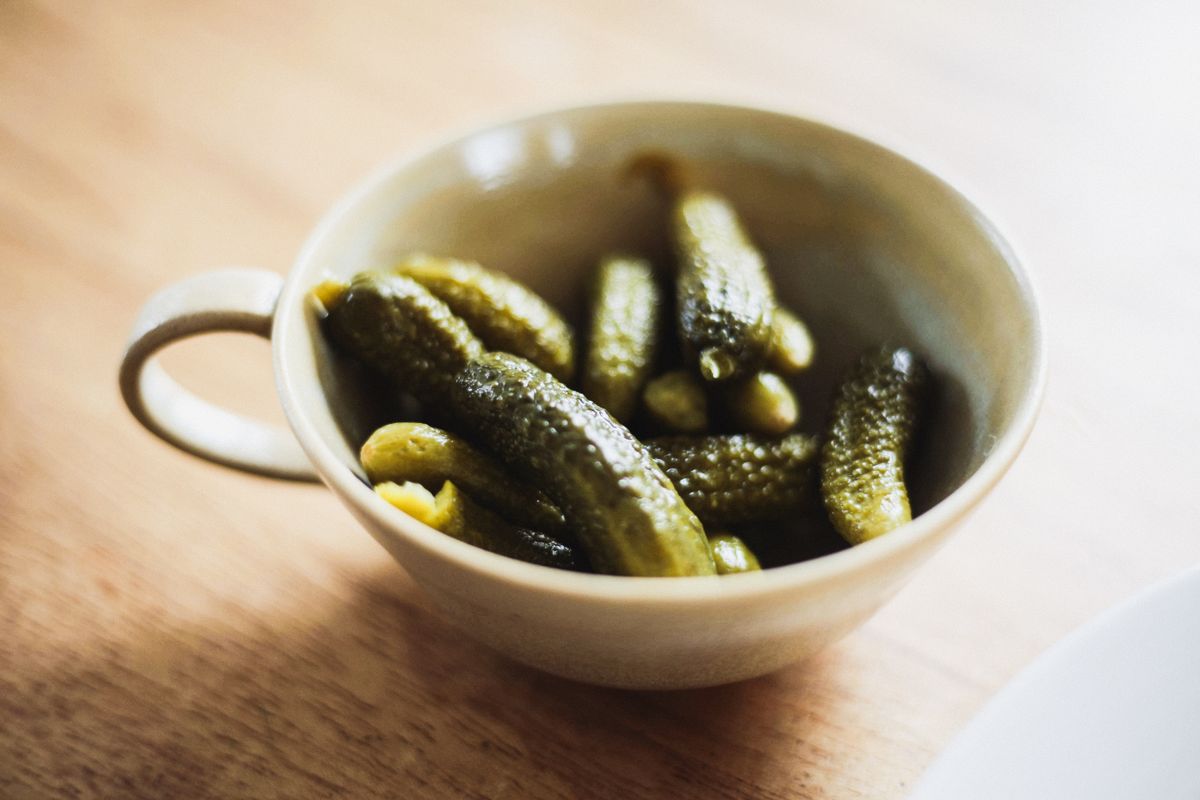
Here is the part almost nobody explains properly, and once you see it you cannot unsee it in the store.
Turn a jar of supermarket pickles around and read it. Vinegar. That is the whole trick. Somebody dropped a cucumber into acid and screwed the lid on. Nothing was made in there. Nothing grew. The sour you are tasting came out of a bottle in a plant somewhere.
Yours makes its own.
The bacteria eat the sugar in the vegetable and produce the acid themselves. That is why your jar goes sour without you adding one single thing. The sourness in your jar is not a flavor somebody poured in. It is evidence, and they are still in there when you take the first bite.
One jar got preserved by killing everything inside it. The other got preserved by filling it so completely with life that nothing harmful can get a foothold.
Both of them keep the cucumber. Only one of them hands you anything.
I'll tell you exactly what's in the jar. What it does for you is between you and your body.
It was the room where food was kept alive through winter. Somewhere along the line we turned the most useful room in the house into long-term parking for cardboard.
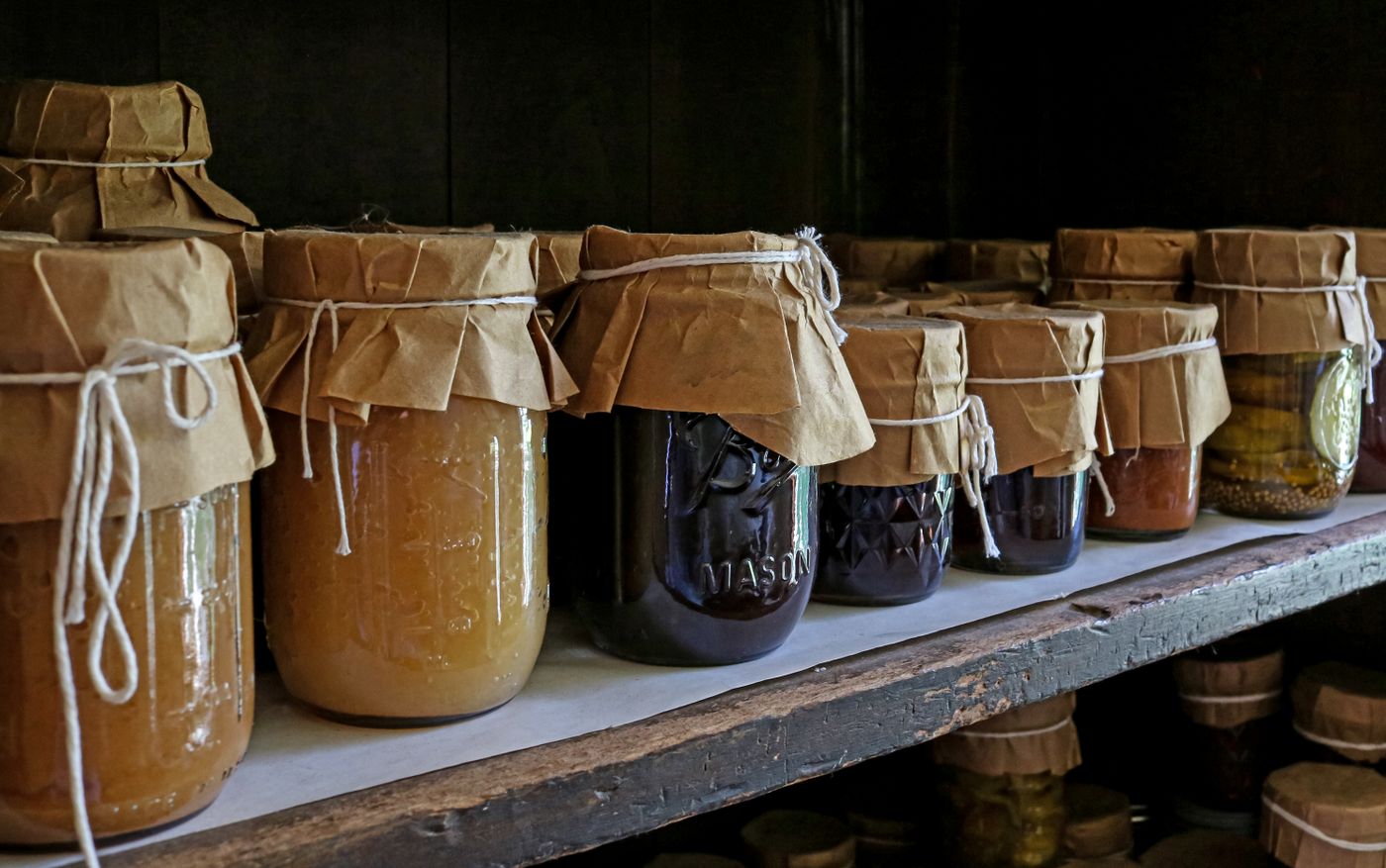
No other kind of preserving can say this. Canning wants fuel, a working stove, a canner and new lids. Freezing wants a grid that stays on, continuously, or you lose the lot. Dehydrating wants electricity or a great deal of sun.
Fermenting wants salt, water, a jar and time.
That is the entire input list. Kept under the brine, a finished ferment holds six months or longer in a cellar at 39 to 46°F, three to six in a cool pantry at 50 to 59°F, and one to three at room temperature. Kraut holds longer than whole pickles, because texture degrades faster in cucumbers. The jar does not become dangerous after those windows. It becomes softer. Those are different things, and I would rather tell you both than let you guess.
It keeps because it is acidic enough to defend itself, not because anything got sterilized. Canning gets there with heat, which is a serious craft that does things fermentation cannot. Different tool, different job. This is the one that leaves the food alive.
You do not need a boat or a bad year for that to be worth something.
You remember March 2020. The water aisle was empty. The shelves were stripped before noon. People were fighting each other in the grocery store over toilet paper. It did not matter which side of anything you were on. Everybody watched it happen and everybody had the same thought: I might have to go out there too.
I had jars. I was not panicked. Not because I saw it coming. Because a pantry full of food you made yourself is not a bet on the world getting worse. It is just a quieter way to live.
That is all a pantry ever was. Not a bunker. A pantry.
You should be able to feed the people at your table without a grocery run. That is not preparedness. That is just being able to cook.
I said about two dollars a jar at the top. Here is where that comes from, because a real number beats an adjective every time.
Those are August 2026 prices and I keep the receipts on file.
One more figure, and I include it because I paid it myself for a stretch and I am not embarrassed about it. I bought fermented brine by the pouch, on subscription, and I drank it every morning. A pouch is nineteen and a half ounces, thirteen shots, $15.99. One a day is $448.92 a year. Their deepest subscription tier brings it to roughly $39 a month, and I am telling you the good number too, because I am not going to quote the worst case and pretend it is the only case.
I loved that ritual and I still do.
The ritual was rented. Every month, the same box, or the habit stops. They took something you do for yourself every morning and turned it into a subscription.
Six filmed sessions. About two hours and forty-five minutes of video, not PDFs. You pack a pint the same night you start.
Somewhere around your tenth jar, somebody is going to offer you money for one.
Then you will go looking for whether that is allowed, and you will get two wrong answers. Half the internet says check your state's cottage food list. The other half says fermented vegetables are federally regulated and you would need a commercial kitchen and a filed process.
Both are wrong, and the second one is wrong in the direction that talks people out of a legal business. The federal acidified-foods rule turns on acid being added, and it carves out anything kept refrigerated. Your jar makes its own acid and lives in the fridge, so it misses that rule twice.
Which makes it a state question, and the states are nothing alike. Texas names fermented vegetable products in its cottage food law. Illinois allows them with a food safety plan and a lab pH test. Ohio bans them outright. I walk you through finding your own state's answer. No income promises, and no pretending it is easier or harder than it is.
$147 once
One payment. Not a subscription, which would be a strange thing for me to sell you after that whole letter.
Instant access. Nothing ships. If you have a scale and a jar you can start tonight.
Pack one jar using the number from session one. If it does not work, email me and tell me what happened. I will refund you in full, and then I will help you fix the jar anyway, because a soft jar is almost always one of four things and I would rather you ended up with pickles than with your money back.
Worth knowing before you compare: go read the checkout pages in this category and you will find "this is a digital product, no refunds" written on several of them. That is a normal position and I understand why people take it. I am taking the other one, because if I am going to sell you a number I had better be willing to stand behind what happens when you use it.
Sixty days. No form, no hoops, and you keep the free calculator either way.
Fair question, and I would rather answer it than hope you do not ask it.
Most of what is for sale in this category is a recipe collection. Nothing wrong with that. If a recipe collection is what you want, go buy the cheaper one with my blessing.
But a recipe does not tell you what is in the salt in your hand. It does not tell you that every mineral salt on the market is somewhere between 83% and 98% sodium chloride, and that the number changes everything about how much you weigh out. To know that, you have to put the salt in a box, mail it to a laboratory, and pay for the analysis. I did that. That is the one thing I sell that nobody can copy by watching my videos.
A recipe does not coach you through the Wednesday night when the jar looks cloudy and smells wrong and you are about to pour it down the sink. This course does. Every failure mode I have seen in two years of batches, what it means, and whether it is fine or finished.
And a recipe does not hand you a morning lineup of eight pours off the jars you already made, bottled in your own colors, at your own heat. The Brine Bar alone is the part most people tell their friends about, and it is built entirely from brine you were going to pour down the drain.
Recipe collections teach you what to make. This course teaches you what is happening inside the jar, and why. You will not need another course after this one.
I would rather sell you the skill one time than rent you the outcome forever.
If that already worked for you, do not read the rest of this page.
Get the course, $147
You can. You can also spend three months scouring forty videos, six forums and a hundred comment threads, absorb a dozen contradicting opinions about grape leaves, and end up with so much information that you never pack a jar. Or you pack one using the wrong salt number and get a soft batch and decide you are not cut out for this. I have watched that happen. I have been that person.
This course hands you the right number on day one and gets you to a finished jar by Friday. Everything else you learn after that is built on a foundation you trust, instead of a pile of free advice you are not sure about. The difference is not the information. It is the order and the confidence.
This is the real one, and it deserves a straight answer rather than reassurance. Submerged vegetables in a correct brine acidify fast, and a finished ferment sits at pH 3.5 to 4.0, below the 4.6 line that food safety work treats as the threshold. That is why the salt number matters so much and why it is the first thing you learn. The last session covers every way a jar can look wrong, which ones are harmless, and which ones go in the bin. You will not be guessing.
Ten minutes at the counter. Slice, pack, weigh, water, lid, date. Then you walk away and the jar does the rest without you. The waiting is not your time. It happens whether you think about it or not, which makes ten minutes on a Sunday buy you weeks of food.
Different craft, and a good one. Canning uses heat, a canner and a burner running for hours. This uses salt, water, a jar and time, with no energy input at all. If you already can, this is the companion skill, not the rival.
Then you are the person I built this for, and you are further along than you think. You followed a recipe correctly and got a soft jar, which means you already ran the experiment that proves the recipe was wrong rather than you. Start with a pint. A failed pint is a cheap lesson you shrug off. A failed half gallon is real food, two weeks of waiting, and quietly never trying again.
That is all five. If none of them are yours, the only thing between you and a jar on the counter tonight is this button.
Get the course, $147
Nothing bad happens. That is what makes it easy. The cart still gets pushed every week, and eight weeks from now you know exactly as much about this as you do right now. Which is what happened the last two times you thought about it.
Ten minutes at the counter. Five days of ignoring it. Then you eat something you made that is alive and crunchy and cost you about a dollar, and you make a second jar, because the second jar is where this stops being a project and becomes what you do. Your third jar you will give away. You will not be able to help it.
You don't have to get it right. You have to get it moving.
Here is exactly what happens next, including the obvious parts.
Click the button. It opens Gumroad, which is where the course lives. The price says $147 and there is no other price. Enter your email and your card, and you get access on the same screen, not in twenty-four hours.
Inside, go to session one first. Do not browse. It is fifteen minutes and it ends with you packing a pint of red onion tonight, which is the fastest ferment in the course. You will be eating it Friday.
Before you start, put three things on the counter. One pint jar. A digital scale that reads grams. One red onion.
And somewhere in the first week, a person in your house is going to open the fridge, look at a jar you made, and ask you whether it is safe to eat. Here is what you say.
"It's onions, water and salt. It's been fermenting five days, which is how people kept vegetables alive before refrigerators. The acid is what makes it safe. Try it."
You will be able to say that because you will know it, and knowing it is the thing you are actually buying.
Two weeks from tonight you are going to open a jar and hear it hiss. That moment cost you about a dollar and ten minutes.
You came to this page as somebody who buys the jar. Somebody who pushes the cart, reads the label if there is time, and takes the manufacturer's word for it because what else is there to do.
You leave as the person in your family who makes it.
That one can feed people without asking permission from a supply chain. That one knows what 2.3% means and why the number on the bag was wrong. And in about two generations, when somebody in your family wants to know how to do this, there is going to be a person to ask.
That is you. That is the whole thing I am selling.
You weigh the salt. I already did the lab report, the percentage and the arithmetic. Your job on step one is one number on a scale.
Get the course, $147One payment. Lifetime access. Sixty days to change your mind, and I'll help you fix the jar either way.

Kevin
The Bread & Brine Society
Toledo steelworker's kid. Combat veteran. I coach capital gains deferrals for celebrities, pro athletes, politicians, business owners. I am not hurting for work. This is not that.
A genetic scientist with nearly $200 million in his own research sat me down years ago and wrecked my whole understanding of food. Beta-glucans pasteurized completely out of the diet. Glycation from ingredients the body was never built to process. A food pyramid built on guidance the meat industry lobbied to water down in 1977, and it stood for 49 years before somebody flipped it upside down this January. He looked at me and said: if that can change, what else should you be looking at?
I have not stopped looking. I turn boxes around now. Every one of them. The nutritional value is depleted but the habit is still there. Breakfast, lunch, dinner. We are overeating dead food and paying more for it every year. I turned the salt bag around and found a number that breaks every fermentation recipe on the internet. Turned the pickle jar around and it was not what I thought it was. Vinegar, not fermentation. Nothing alive in the jar. That pissed me off. These are simple things that carry a big impact. Salt, water, a jar, and five days on the counter.
Teresa and I make everything ourselves now. It changed things we did not expect it to change. I will tell you exactly what is in the jar. What it does for you is between you and your body. But I will say this: we did not expect it, and we are not going back.
P.S. The salt chart inside the course lists the tested sodium chloride percentage for the brands people actually buy. It is the only page I have had independently documented, and it is the page I would steal if I were somebody else. Session three.
P.P.S. The calculator below stays free forever. Pack a pint tonight using it and you will be eating something alive on Friday without paying me a dollar. I would rather you tested me first.
P.P.P.S. If you are not buying today, get on the list. The crunch guide, the salt chart, and the reason the most famous quote in gut health is fake. No purchase attached.
Six filmed sessions, about two hours forty-five minutes total, plus the salt chart and the diagnosis reference. Access lands on the screen the second you pay. Nothing ships and there is nothing to wait for.
A pint jar, a digital scale that reads grams, and a glass fermentation weight to hold the vegetables below the brine. That is the list. No crock, no airlock, no fermentation chamber, no pH meter. I teach in pint and quart jars on purpose, because that is what is already in your cupboard. The glass weights run about four dollars and they are the one thing worth buying.
Red onions are ready in five days and they go first for exactly that reason. Cucumbers and peppers run about a week. Cabbage takes two to three weeks, which is why it is not where you start.
Not the refined table salt in your cupboard. That is stripped, bleached, and about 99% sodium chloride with anti-caking agents. You need an unrefined mineral salt. I use Salt of Life personally, every meal, and it is the salt I had lab-tested. The course teaches you to read any mineral salt's lab report and correct for it, and the free calculator has the common brands already loaded.
No. One price, one product, one payment. The page you land on after checkout is the course.
Email me within sixty days and I refund you in full, no form and no questions. Then I will still help you diagnose the jar, because I would rather you ended up with pickles.
It is built for somebody who has never done it. The whole reason it exists is that the internet made a ten-minute job sound like chemistry. If you can slice an onion and read a scale you are qualified.
Fair question and it deserves a real answer rather than a pat on the head. A finished vegetable ferment sits at pH 3.5 to 4.0, under the 4.6 threshold food safety work treats as the line. Salt at the front and acid at the back are the whole safety system, which is why the weighed number is not a nicety. The last session covers every way a jar can look wrong and what each one means.
Mineral salt is not pure sodium chloride. It is closer to 83%, because the rest is minerals and moisture. So when a recipe says use 2.5% salt, your jar ferments at about 2.1%. Both sit in the safe range. Only one of them repeats.
Make your first three batches in pints. A pint is a small amount of vegetables, so a jar that goes wrong is a cheap lesson. Scale up to quarts once you have a result you liked twice.
Weigh this much salt
0 grams
That is the free tool, and it stays free. The course gives you every ferment gram for gram, how to pick your salt, the Brine Bar lineup, and what to do when something looks wrong. See what's inside
Salt percentages here are published estimates and my own lab work, and each one is labelled with a tilde for that reason. When the certificates of analysis land, these numbers get updated to whatever the lab says, including if the lab disagrees with me.
The crunch guide, the salt chart, and the first-jar walkthrough. Same corrected number the course uses. No cost and no course required.
No spam. Unsubscribe anytime.
There is a bread side, a growing library, and a room filling up with people putting food up the old way because it turns out that was never a bad idea. You get in by packing a jar, not by knowing the right person.